Storiis Support
Story
Updated
The Story section is about the story itself—not the individual pieces used to build it.
This is where you establish the promise you are making to the audience: what kind of story this is, who stands at its center, what question pulls it forward and what it should feel like to read. You will almost certainly revise these answers as the Plan develops. That is not a sign that the original answers were wrong. It is a sign that you have, inconveniently, continued thinking.
The section is divided into Overview, Key Cast, Outline and Tone & Style.
Overview
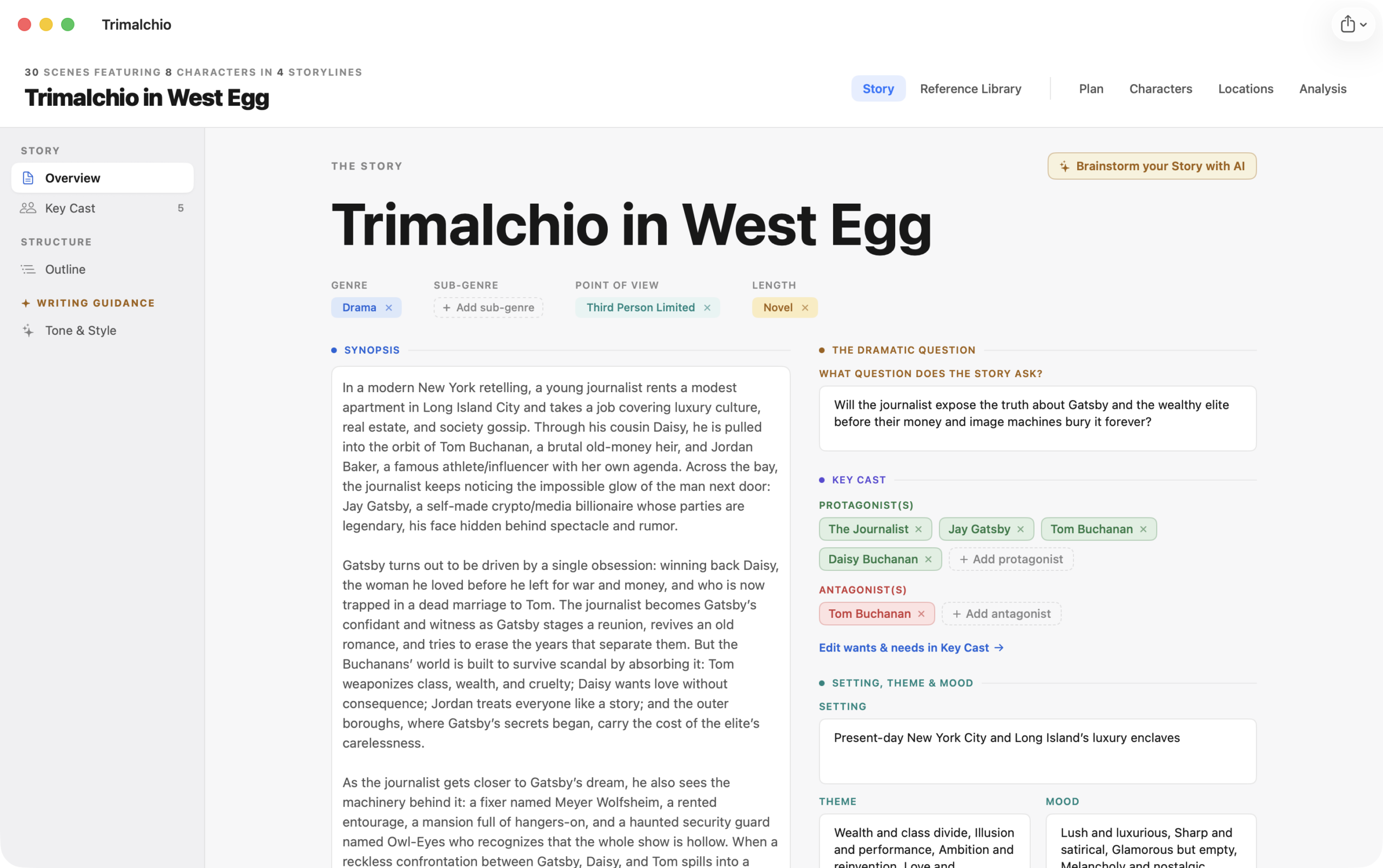
Overview holds the story’s core identity.
Story Details
Add the story title, genre, subgenres, point of view and intended length. Selecting a genre enables its related subgenre choices. Length provides a useful scale for AI brainstorming and for your own structural expectations; it does not impose a hard word limit.
Synopsis
Write a concise account of the central situation, conflict and likely direction of the story. It can begin as a paragraph and become more precise as you plan.
A useful working synopsis answers:
- Who is the story primarily about?
- What changes or disrupts their life?
- What do they attempt to do about it?
- What meaningful resistance stands in the way?
Setting, Theme and Mood
Setting describes the story’s broad time and place. Specific places belong in Locations, while detailed world material belongs in the Reference Library.
Theme captures the ideas the story explores. Mood describes its emotional atmosphere. Neither needs to be a grand declaration suitable for carving above a university library. “Found family” and “uneasy but hopeful” are perfectly useful planning answers.
The Dramatic Question
The dramatic question is the central uncertainty that keeps the audience moving forward. It should be specific enough to imply stakes and open enough that the story can genuinely answer it either way.
For example: “Will Mara expose the town’s secret without becoming the kind of person who created it?”
Key Cast
Assign existing characters—or create new Main characters—as protagonists and antagonists. The Key Cast is the handful of people at the center of this particular story; your complete roster remains in Characters.
Comparable Titles
Add stories that sit beside yours in genre, audience, tone or premise. Comparable titles can clarify the experience you are aiming for without requiring your story to imitate them.
Key Cast
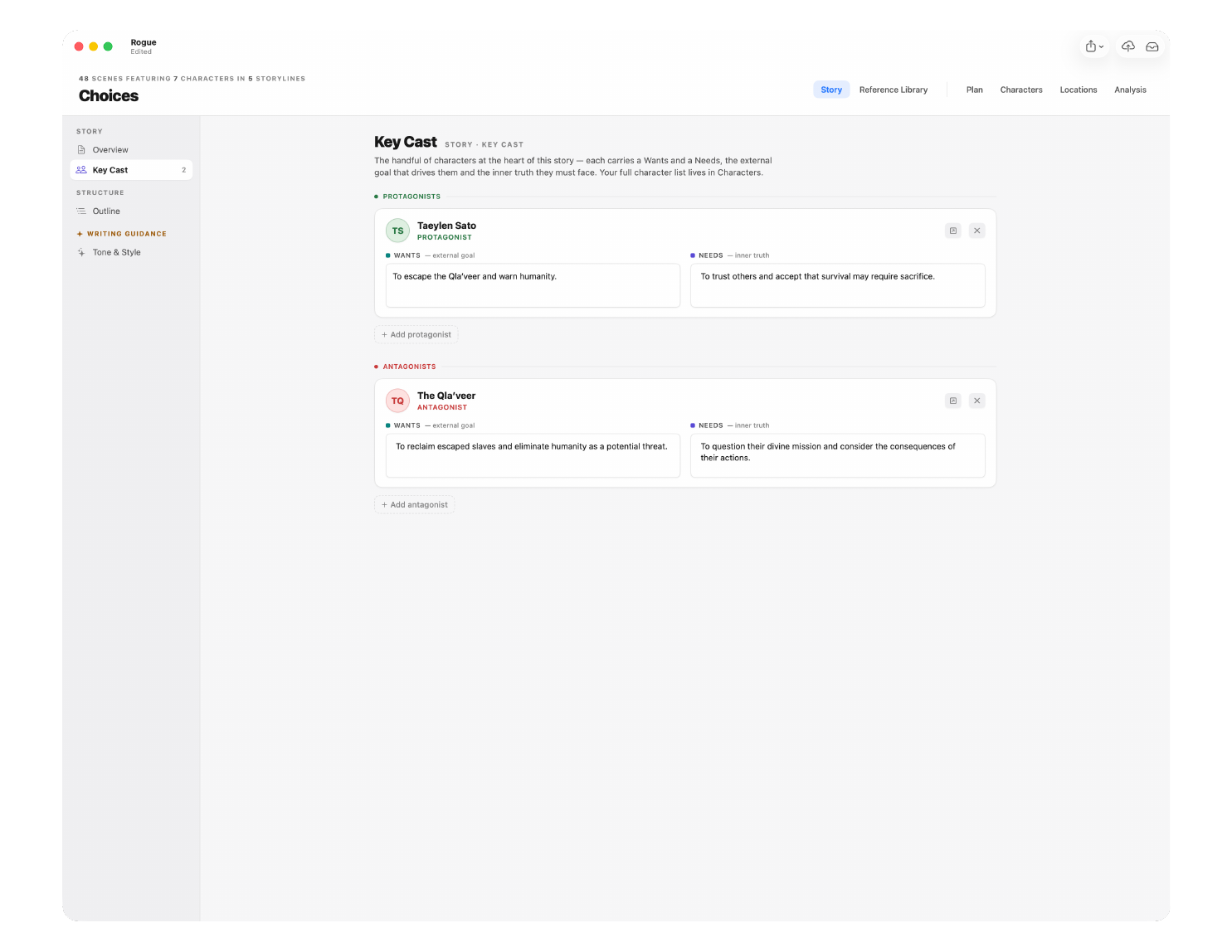
Key Cast gives your central characters more room and focuses on two essential forces:
- Wants are the external things a character consciously pursues.
- Needs are the inner truths, changes or realizations the story asks them to face.
You can select an existing character or create a new one. New characters are added to the Characters roster as Main characters, where you can build out their complete profile.
Wants and Needs are not required to align neatly. In many stories, the friction between them is where the character arc lives.
Outline
Outline is a long-form, styled editor for describing the story act by act, beat by beat—or in whatever structure is useful to you.
The outline and the Plan serve different purposes:
- The outline is free-form prose. It is good for thinking through the whole story quickly and expressing transitions or intentions that do not yet belong to a formal scene.
- The Plan is structured. Its storylines, beats, scenes and connections can be filtered, visualized, analyzed and exported.
You can begin in either place. Many writers use the outline to discover the broad shape, then turn that material into storylines and scenes. Others build the Plan first and use the outline as a readable statement of what they have made.
Use Outline with AI when you want help developing or revising the outline from your existing story context. Review proposed changes before applying them.
Tone & Style
Tone & Style is writing guidance rather than story canon. It helps define how future prose should sound, particularly when an AI tool drafts from the Plan.
You can specify:
- Narrative voice and tense
- Prose style and level of descriptive detail
- Authors or books that influence the desired style
- Clichés, habits and AI-writing tells to avoid
- Reference passages that demonstrate the intended voice
- Standing directions for a writer
Complexity and Maturity
Choose an audience to establish sensible defaults, then adjust prose complexity, detail density, content maturity and sexual-content level individually.
These settings guide generated prose; they do not censor or remove anything you write manually. Explicit sexual content may only involve adult characters.
Brainstorm Your Story with AI
Select Brainstorm your Story with AI from Overview when you want help turning a premise into structured story material.
The guided process can develop the overall story, characters or scenes. Depending on the path you choose, you can decide which deliverables should be created, review the results and optionally build supporting Reference Library material or character portraits.
Existing canon is supplied as context so the assistant can extend the story rather than unknowingly replace it. Storiis does not apply the result until you accept it.
For a full guided example, see Example AI-Assisted Workflow.
A Useful Working Habit
Return to Story after major changes to the Plan. If your scenes now tell a richer, stranger or more interesting story than your synopsis describes, update the synopsis. The Story section is a compass, not a contract you signed before you knew where the road went.