Storiis Support
Getting Started
Updated
Storiis helps you build the foundation of your story before—and while—you write it.
The act of writing is often portrayed as a cozy and romantic activity. Perhaps you’ve imagined yourself at your antique wood desk, filling your artisanally-crafted leather-bound notebook with magic smoothly flowing from your hand-crafted fountain pen (not a gauche, eraser-equipped pencil, of course; only uninspired hacks need an eraser — and let’s not even discuss something so rude as a computer). You finish your finest work, then celebrate with a sip from your chamomile tea while relaxing to the sounds, smells and sights of the ocean waves crashing against the jetties just outside your office window. You hear your phone buzz from another room — it’s probably your agent calling about the latest movie deal you’ve been pitched. Again — but it can wait. This is your moment.
Unfortunately, the reality of being an author—published or otherwise—doesn’t always quite match this beautiful ideal.
Writing may be your second or third job — throw in some kids, and it’s probably your eighth job. You have thousands of ideas swirling around your head and no way to organize them. You find an hour to write, then spend half of it trying to remember where you left off and where you’re supposed to go. By the time you reach the final act, the subplot you introduced eighteen months ago has quietly changed its name and moved to another country.
These aren’t failures of imagination. Stories are complicated systems. Characters need agency and change. Storylines need development and resolution. Reveals need setup, consequences need causes and every exciting idea still has to occupy some particular scene at some particular point in time.
That is structural work. It’s the framing of the house and the pencil-drawings beneath the paint: the structure that lets the art shine. In Storiis, we call that structure the Plan.
What the Plan Does
The Plan is where you work out your load-bearing storylines and the beats that move them. It connects scenes to characters, locations, exposition, timing and structure so that you can see how the parts affect one another.
It is also a place to experiment. Add a subplot. Remove a character. Move a reveal. Try the version where the terrible dinner happens before the arrest. You can test a story-level change in a fraction of the time it would take to draft three chapters and discover that it doesn’t work.
Planning is not a promise that your draft will obey. It gives you a clear route to begin with—and a map you can revise when the story finds a better road.
Your First Ten Minutes
Create or open a story, then give yourself a deliberately small first pass:
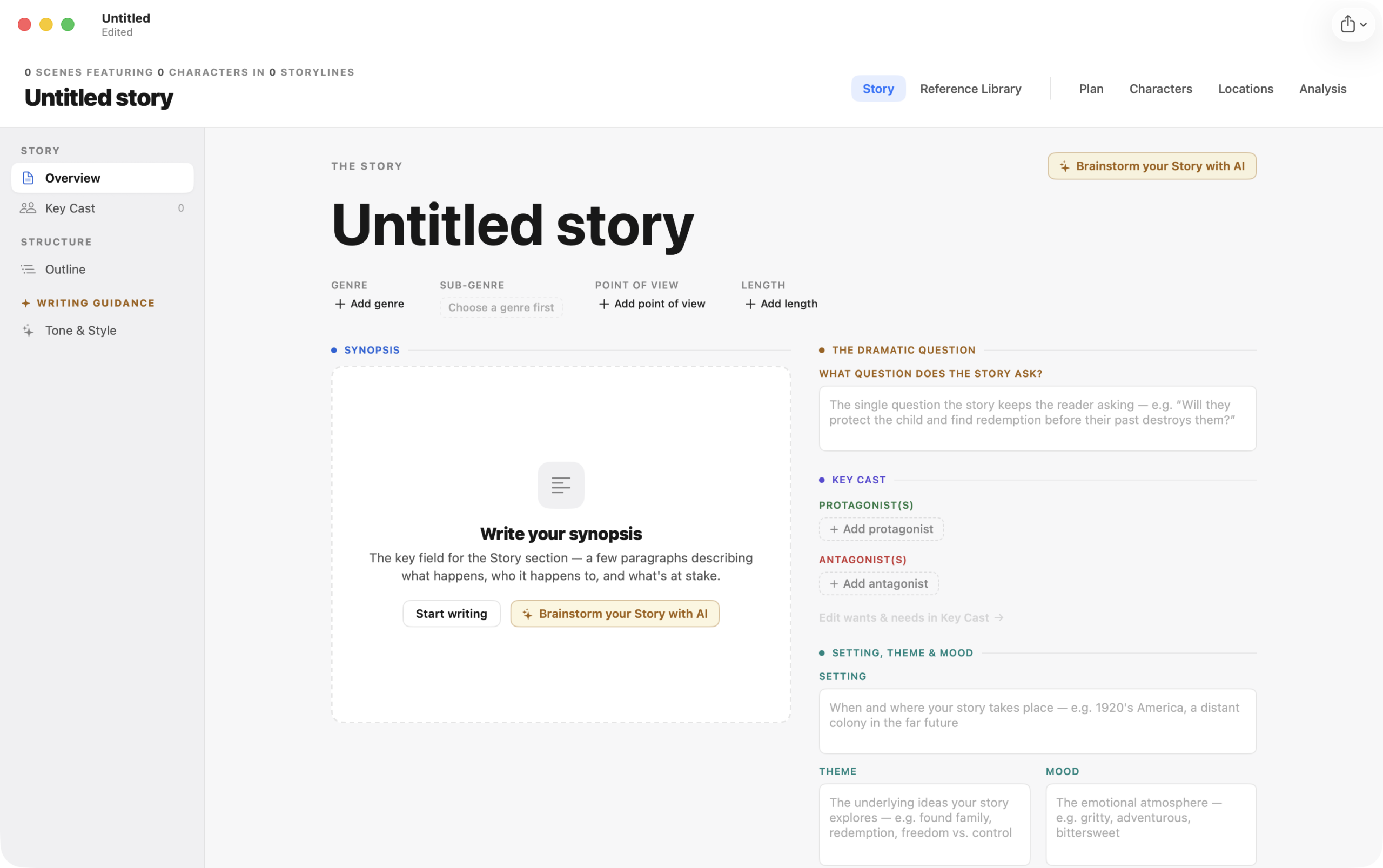
- In Story, add a title, short synopsis and dramatic question.
- In Characters, create the protagonist and the person or force most directly opposing them.
- In Plan → Scenes, add the opening scene and describe what changes by its end.
- Create one main storyline in the Storylines panel and add its first few beats.
- Connect the opening scene to the beat it advances.
That is enough to establish the basic Storiis pattern: define an idea, turn it into a dramatic thread, then make that thread happen through scenes.
Where Things Live
Storiis is organized into six main sections:
- Story describes the work as a whole: overview, outline, key cast, tone and style.
- Reference Library holds worldbuilding, whiteboards, notes, reference timelines, index cards and attachments.
- Plan builds the story through storylines, beats, scenes, timing, cards and summaries.
- Characters develops the cast and their journeys.
- Locations maintains the settings connected to scenes.
- Analysis reviews the Plan through several AI-assisted structural lenses.
See Navigating through Storiis for a fuller tour.
How Much Detail Do You Need?
Only the detail that helps you make the next useful decision.
Some writers will fill every profile field and time every scene to the minute. Others will use a title, one sentence and a handful of beats until the story has earned more attention. Storiis supports both approaches.
Empty fields aren’t unfinished homework, they’re available tools.
Choose a Guided Path
For a step-by-step route from blank story to workable Plan, follow Example Workflow. It uses the manual tools and shows one potential flow—not the One True Way handed down on a stone tablet.
To see where AI can assist without taking control of the work, follow Example AI-Assisted Workflow. For a feature-by-feature reference, see AI Tools.
If you are looking for a particular feature, start with FAQ or one of the section guides linked above.
Stop trying to build your metaphorical airplane while it is in mid-flight. Give it a Plan first so that you can let it soar.