Storiis Support
Summary
Updated
Summary turns your scene plan into something you can read from beginning to end. It is a useful change of altitude: after spending hours adjusting beats, cast and timing, you can ask whether the story itself still makes sense.
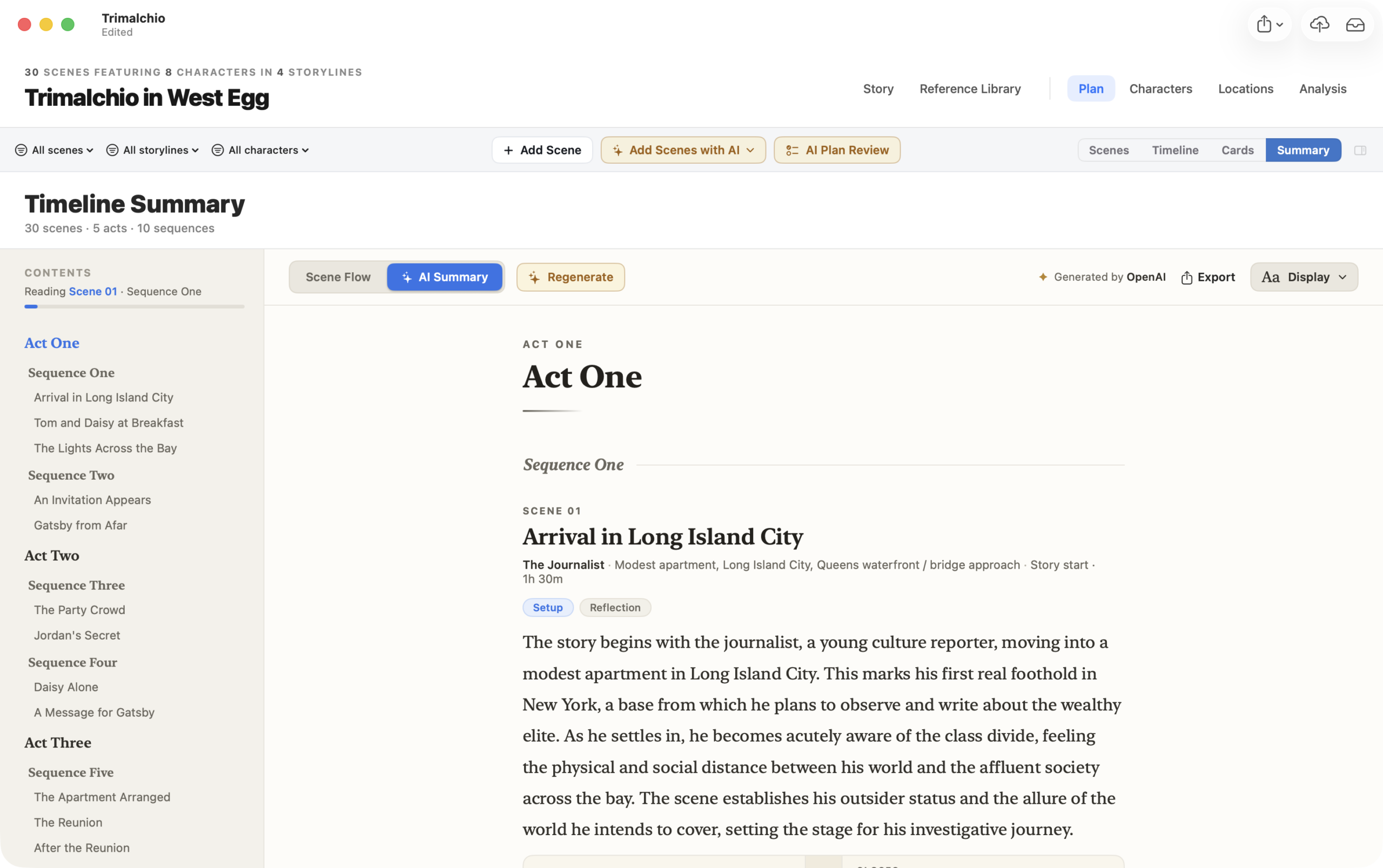
Scene Flow
Scene Flow is built from the information already in your Plan. It presents scenes in narrative order, grouped by the current act and sequence or chapter structure.
Use the contents rail to move through the summary. Select a scene heading to return to that part of the Plan when you find something that needs work.
Because Scene Flow uses your own scene details, it updates as the Plan changes and does not require an AI request.
AI Summary
AI Summary produces a more continuous prose account of the planned story. It is useful for testing how the pieces read as a whole and for sharing a compact overview with a collaborator.
Generate or update it when you choose. Storiis marks the summary when the underlying Plan has changed since its last generation, so an older summary is not quietly presented as current.
AI Summary uses credits. Storiis shows an estimate before the request, and you review the resulting text in the Summary view.
Display Options
Adjust the reading view to suit the task. Options include:
- Serif or sans-serif type
- Text size
- Reading width
- Paper-style presentation
These controls change the display, not the Plan content.
Exporting a Summary
Summary can export to:
- Plain text
- Word
- Google Docs
Choose the export that matches what happens next: plain text for flexibility, PDF for a stable reading copy, Word for editing and Google Docs for collaboration.
These Summary exports are separate from the broader options under File → Export. See Export Options for scene tables, Scrivener projects and story bibles.
A Useful Review Pass
Read Scene Flow without editing the first time. Mark only the places where you become confused, impatient or strangely aware of the refrigerator.
Then return to the Plan and ask whether each problem comes from missing information, weak scene purpose, poor ordering or a storyline that has gone quiet. Summary is most valuable when it helps you diagnose the Plan rather than merely admire its formatting.