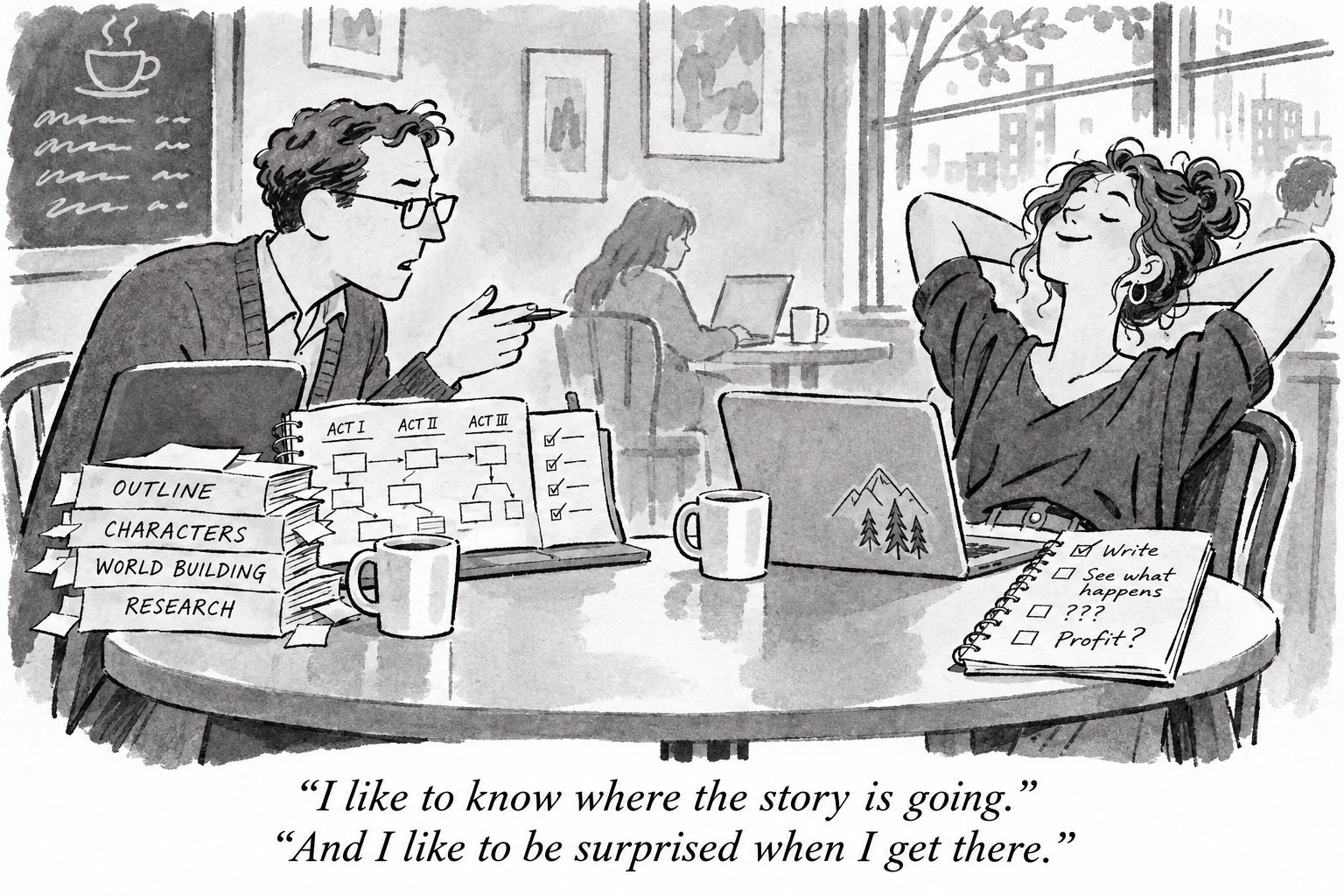
It’s the eternal question each author will ask themselves at least once in their writing career: Do I plan my novel before writing it, or should I just figure it out along the way. This is otherwise known as the GREAT PLOTTER vs. PANTSER DEBATE.
(Dramatic capitalization added for greater dramatic flair.)
Confession time: I was once a pantser. A dedicated one, even. I knew the story I wanted to write, the characters and their storylines were vivid and fully-formed in my mind; my story flowed, with an easy thousand words gliding like silk onto the page each time I sat down to write.
The best part was that I didn’t need a plan, it all just came to me as I scribed. Plotting was for those boring kids in school that had to study every night and took meticulous notes — who took everything just a bit too seriously — unlike the cool kids like me who could just wing it and make it work.
For months I wrote like this, each session an unbridled unleashing of literary genius upon unsuspecting and unworthy digital pages until, eventually, I’d assembled a magnum opus stretching more than 150,000 words. It was then I paused to take stock of what I’d written, to bask in the glow of its greatnes—
And that’s when it hit me. I’d probably need at least another hundred-thousand words to get to an ending, assuming I could even figure out how the story should end. What I’d written had turned out wildly different than my original idea.
But what was worse was that the story had no soul. No emotional through-line; nothing for the reader to really grab onto beyond, “this thing happened, followed by another thing”. Sure, I thought the story was interesting and my characters had some unique, fun personalities, but… there was nothing emotionally substantial to really make the reader care.
So I went back and tried to figure out where in my story I could add an emotional through line. I figured there were plenty of opportunities to do so, and of course there were, but each time I imagined how such a thing might be done, I also foresaw the huge amount of rewriting needed to make it work with the storylines I’d spent months writing — which would be in-addition to the huge rewrite I’d need to do to ensure an ending happened before 300,000 words… and several more months of writing. (I won’t even get into the too-many subplots and storylines I’d setup and never paid off.)
Wow, did this take the wind out of my sails. To this day, that ‘finished’ novel still sits un-published in my drafts folder. I’ve of course tried to go back and revise it, several times actually, but I’ve yet to find the magic that would make it all work without completely rewriting it.
Oh, and that book took almost twelve months to write; twelve months that were now basically tossed down the drain. Sure, I learned a whole lot, and I enjoyed the experience of writing the story — those things shouldn’t be discounted as worthless — but my goal is to get my books out there, to have them read and enjoyed, not to sit and gather virtual dust.
This tale of woe I just told you? Just for fun, I got to experience three more variations of it. I wrote three more books, each the same way as the first, and each one inevitably ended up in the same mess. A story that kinda worked, but… not really.
So it was on my fifth book that I finally decided I should try a different approach. (Yah, I’m a bit of a slow learner.) This time I would try planning my story, first. Actual, honest-to-god figuring out what the hell I was going to write before I spent another umpteen months writing it.
I set my mind to planning with enthusiasm. I created dozens of spreadsheet-based story- and plot-grids. I used Scrivener (my drafter of choice), Plottr, Aeon Timelines, Story Planner, and every other tool I could find out there. I tried mind mapping software and dedicated outlining software. I must have gone through every tool on the App Stores and interwebs looking for something that would do the trick for me, but I always ended up getting frustrated. A frustration expressed in several different forms, but which always boiled down to one thing: lack of dimensionality, or to put it more simply: every tool and process I tried captured only one or two aspects of story writing, usually just the plot, and maybe, if I were lucky, something about the characters.
But a story has so much more; the characters have arcs to fulfill and they do stuff that impacts storylines! Storylines with multiple interweaving plots and subplots, all of which might be planned sequentially but told out of order! What about the setting and how, in one scene, the location is ominous, but in another that same location should be described as bright and cheery? And exposition! Most of my stories are science fiction, so somewhere I had to fit in important key contextual facts… but how do I plan where they go so as not to info dump and overwhelm the reader?
Hardest of all was how would I document and track all of this in a way that’s actually usable when I sit down to finally write the damn thing? Most importantly: how could I make sure what I wrote made sense to me and, when finally written to prose, be engaging to a reader? A thousand-column-wide spreadsheet wasn’t going to cut it.
And so the solution to all that (and more) became Storiis, the planning tool that could be shallow when I only wanted a simple outline, or go deep when I wanted to plot and plan out every last detail of my story — all while being easy to use and usable for writing my stories.
I don’t know if you, gentle reader, have the same issues I have when writing a novel, but if you find yourself nodding along with my little story and suffering through multiple rewrites, dealing with storylines that go nowhere, or the dreaded sagging middle-act, I suggest you give Storiis a look.
In future posts I’ll detail out Storiis’ many fancy features, and I’ll even try to put on my game face and make some video demonstrations — but the truest test is simply for you to download and give it a try; see if it can solves some story problems for you and save you from the churn.