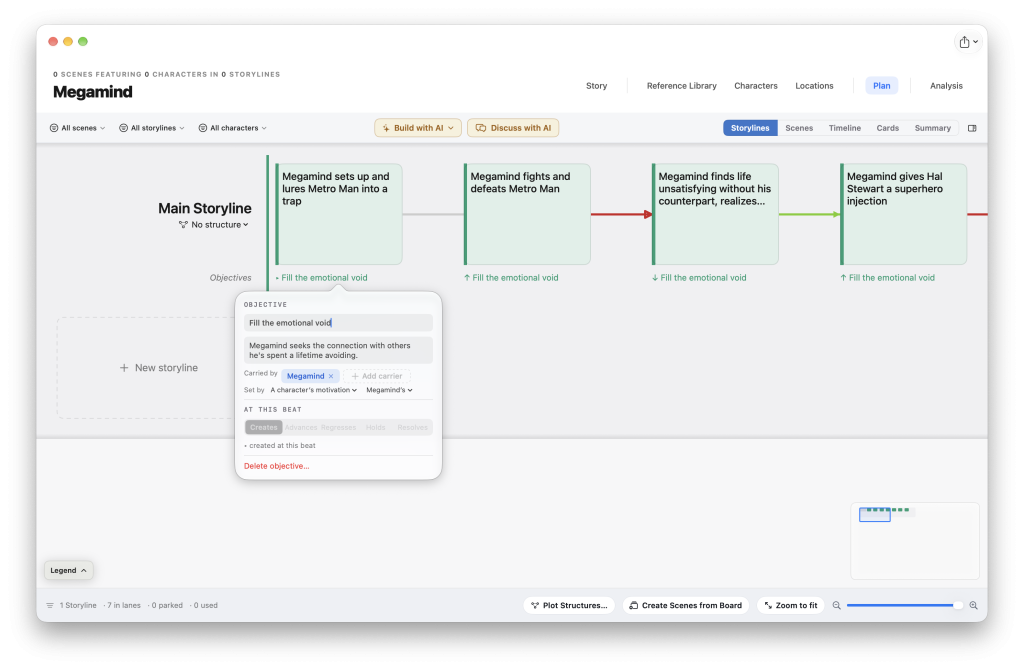
One of Storiis’ unique features is its ability to let you set character objectives alongside their storyline beats — but what are character objectives? Simply put, they let you define and track an objective your characters are pursuing which, while occurring within the structure of a storyline, is not necessarily defined by, or in lock-step with the beats of that storyline.
For an example of how objectives are different from, and add value to a basic plot outline, I’ll use the movie Megamind, a criminally underrated movie — spoiler alert if you haven’t yet watched it!.
In Megamind, the titular villain character, after supposedly and finally defeating his arch-enemy, the hero Metro Man, realizes that without his arch-enemy he doesn’t get any satisfaction from being the villain. Without Metro Man and the relationship they shared (toxic as it might have been), his life is empty of meaning. So what does he do? He decides to create a new nemesis with which he can recreate the relationship he had with Metro Man: Titan.
Naturally things go awry when Titan, after being turned into a nearly unstoppable superhero by Megamind, decides that he’s actually going to be the villain and that he has no interest in being in a frenemy relationship with Megamind. The two fight and eventually Megamind manages to defeat him, but only after receiving some help from his other long-time frenemy, Roxanne.
In a normal plotting scenario, you might lay out your beats like this:
- Beat 1: Megamind sets and lures Metro Man into a trap
- Beat 2: Megamind defeats Metro Man
- Beat 3: Megamind is bored, realizes he needs a nemesis
- Beat 4: Megamind gives Hal Stewart the superhero pill
- Beat 5: Hal Stewart (now Titan) turns evil and tries to kill Megamind
- Beat 6: Megamind defeats Titan with Roxanne’s help
- Beat 7: Megamind finds friendship with Roxanne
Ok, so far so good. Our storyline beats progress well, we have a logical consistency of action with an engaging turning of fortunes, and we know how we’re going to land our (metaphorical) plane.
But here’s something missing: Why. Why are these action happening? Our plot beats don’t provide any real answer, so let’s fix that by adding a character objective.
- Beat 1: Megamind sets and lures Metro Man into a trap
- MM’s Objective: Fill his emotional void. Megamind thinks that if he defeats Metro Man, he’ll finally get the meaningful life he’s been looking for.
- Beat 2: Megamind defeats Metro Man
- Objective Progress: Positive. He succeeds in defeating his enemy!
- Beat 3: Megamind finds life unsatisfying without his counterpart, realizes he needs a nemesis
- Objective Progress: Negative. He realizes that it was the relationship he had with Metro Man (even if it was a bit toxic) that mattered, not whether he won or lost.
- Beat 4: Megamind gives Hal Stewart a superhero injection
- Objective Progress: Positive. He thinks he’s found a new companion to have a frenemy relationship with.
- Beat 5: Hal Stewart (now Titan) turns evil and tries to kill Megamind
- Objective Progress: Negative. The relationship he hoped for won’t happen.
- Beat 6: Megamind defeats Titan with Roxanne’s help
- Objective Progress: Neutral
- Beat 7: Megamind finds friendship with Roxanne
- Objective Progress: Resolved. Megamind realizes that he can have a normal, non-contentious relationship with someone and, in doing so, the emotional void is filled.
With character objectives added to the plot beats we now understand the motivations — the why the plot beats happen and what makes them meaningful. Further, when we sit down to write our story, we also now know to include the subtext and actions that show these character moments.